Showing posts with label sharks. Show all posts

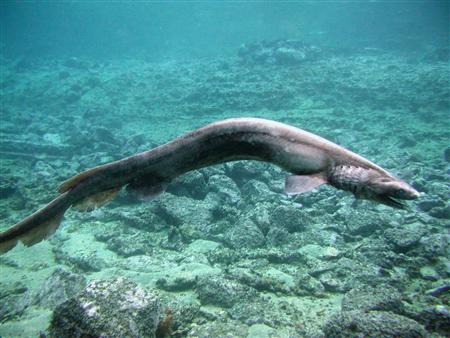
Frilled Shark

 
Name:
frilled shark
Scientific Name: Chlamydoselachus anguineus
FAQ:
  • The frilled shark (Chlamydoselachus anguineus) is one of two extant species of shark in the family Chlamydoselachidae, with a wide but patchy distribution in the Atlantic and Pacific Oceans. This uncommon species is found over the outer continental shelf and upper continental slope, generally near the bottom though there is evidence of substantial upward movements. 
  • It has been caught as deep as 1,570 m (5,150 ft), whereas in Suruga Bay, Japan it is most common at depths of 50–200 m (160–660 ft). Exhibiting several "primitive" features, the frilled shark has often been termed a "living fossil". 
  • GROWTH: It reaches a length of 2 m (6.6 ft) and has a dark brown, eel-like body with the dorsal, pelvic, and anal fins placed far back. 
  • Its common name comes from the frilly or fringed appearance of the gill slits, of which there are six pairs with the first pair meeting across the throat.
  • Seldom observed, the frilled shark is speculated to capture its prey by bending its body and lunging forward like a snake. The long, extremely flexible jaws enable it to swallow large prey whole, while the many rows of small, needle-like teeth prevent escape. 
  • DIET: It feeds mainly on cephalopods, while also consuming bony fishes and other sharks. 
  • This species is aplacental viviparous: the embryos emerge from their egg capsules inside the mother's uterus, and are sustained to term primarily by yolk. The gestation period may be as long as three and a half years, the longest of any vertebrate. 
  • Between 2 and 15 young are born at a time; there is no distinct breeding season. 
  • Frilled sharks are occasionally captured as bycatch by commercial fisheries but have little economic value. This shark, or a supposed giant relative, has been suggested as a source for reports of sea serpents.

Cookie Cutter Shark


Name:
cookiecutter shark
Scientific Name: Isistius brasiliensis
FAQ:
  • The cookiecutter shark , also called the cigar shark, is a species of small dogfish shark in the family Dalatiidae. 
  • This shark occurs in warm, oceanic waters worldwide, particularly near islands, and has been recorded from as deep as 3.7 km (2.3 mi). It migrates vertically up to 3 km (1.9 mi) every day, approaching the surface at dusk and descending with the dawn. 
  • GROWTH:Reaching only 42–56 cm (17–22 in) in length, the cookiecutter shark has a long, cylindrical body with a short, blunt snout, large eyes, two tiny spineless dorsal fins, and a large caudal fin. 
  • It is dark brown in color, with light-emitting photophores covering its underside except for a dark "collar" around its throat and gill slits.
  • The name "cookiecutter shark" refers to its feeding habit of gouging round plugs, like a cookie cutter, out of larger animals. Marks made by cookiecutter sharks have been found on a wide variety of marine mammals and fishes, as well as on submarines, undersea cables, and even human bodies. It also consumes whole smaller prey such as squid. 
  • Cookiecutter sharks have adaptations for hovering in the water column and likely rely on stealth and subterfuge to capture more active prey. Its dark collar seems to mimic the silhouette of a small fish, while the rest of its body blends into the downwelling light via its ventral photophores. When a would-be predator approaches the lure, the shark attaches itself using its suctorial lips and specialized pharynx and neatly excises a chunk of flesh using its bandsaw-like set of lower teeth. 
  • This species has been known to travel in schools.
  • The intrinsic green luminescence of the cookiecutter shark is the strongest known of any shark, and has been reported to persist for three hours after it has been taken out of water .The ventrally positioned photophores serve to disrupt its silhouette from below by matching the downwelling light, a strategy known as "counter-illumination", that is common among bioluminescent organisms of the mesopelagic zone. The individual photophores are set around the denticles and are small enough that they cannot be discerned by the naked eye, suggesting that they have evolved to fool animals with high visual acuity and/or at close distances.
  • Set apart from the glowing underside, the darker, non-luminescent collar tapers at both sides of the throat and has been hypothesized to serve as a lure by mimicking the silhouette of a small fish from below. The appeal of the lure would be multiplied in a school of sharks. 
  • If the collar does function in this way, the cookiecutter shark would be the only known case of bioluminescence in which the absence of light attracts prey, while its photophores serve to prevent premature detection by incoming would-be predators. As the shark can only match a limited range of light intensities, its vertical movements likely serve to preserve the effectiveness of its disguise across various times of day and weather conditions.
  • DIET: Virtually every type of medium to large-sized oceanic animal sharing the habitat of the cookiecutter shark is open to attack: bite scars have been found on cetaceans, dugongs, sharks, deepwater stingrays, and bony fishes.  The cookiecutter shark also regularly hunts and eats entirely squid

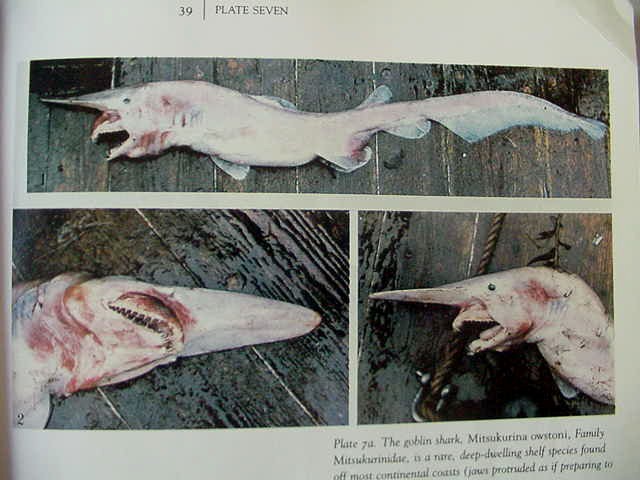
Goblin Shark


Name : Goblin Shark
Scientific Name: Mitsukurina owstoni
FAQ:
  • Size: Goblin sharks can grow to 11 feet (3.3 m) long and weigh 350 lb (159 kg)
  • Diet: Goblin sharks feed on a variety of organisms that live in deep waters. Among some of their known prey are deep-sea squid, crabs and deep-sea fish. Very little is known about the species' life history and reproductive habits, as encounters with them have been relatively rare.
  • The most distinctive characteristic of the goblin shark is the unorthodox shape of its head. It has a long, trowel-shaped, beak-like rostrum or snout, much longer than other sharks' snouts. Some other distinguishing characteristics of the shark are the color of its body, which is mostly pink, and its long, protrusible jaws.
  • Due to this sharks jaw which can elongate and shrink simultaneously when it is hunting. Moreover needle like teeth are helpful for piercing prey and prevent it from escaping.
  • Since this shark lives at a depth of 200 meters and more, this sharks are rare and not a threat to human.
  • The jaws of Goblin Shark are known to fetch very high price in the market

DANGER RATING: 1/5

Tiger Shark


Name: Tiger Shark
Scientific Name: Galeocerdo cuvier,
FAQ:
  • SIZE: Tiger sharks are relatively large macro predators, capable of attaining a length of over 5 m (16 ft). This shark typically reaches maturity at lengths of 2 to 3 m (6.6 to 9.8 ft).
  • It is found in many tropical and temperate oceans, and is especially common around central Pacific islands.
  • Its name derives from the dark stripes down its body, which resemble a tiger's pattern and fade as the shark matures. 
  • GROWTH: Males reach sexual maturity at 2.3 to 2.9 m (7.5 to 9.5 ft) and females at 2.5 to 3.5 m (8.2 to 11 ft)
  • Diet: The tiger shark is a solitary, mostly night-time hunter. Its diet involves a wide range of prey, including crustaceans, fish, seals, birds, smaller sharks, squid, turtles, sea snakes, and dolphins.
  • While the tiger shark is considered to be one of the sharks most dangerous to humans, the attack rate is surprisingly low according to researchers. 
  • The tiger is second on the list of number of recorded attacks on humans, with the great white shark being first.. They often visit shallow reefs, harbors and canals, creating the potential for encounter with humans.
  • Tiger sharks are considered a near threatened species due to excessive fining and fishing by humans.
 DANGER RATING: 4/5

Great White Shark


Name: Great White Shark
Scientific Name: Carcharodon carcharias
FAQ:
  • Size: The great white shark is very well known for its size, with the largest individuals known to have approached or exceeded 6 metres (20 ft) in length and 2,268 kilograms (5,000 lb) in weight.
  • Growth: It reaches at around 15 years of age and can have a life span of over 30 years. 
  • The great white shark is the world's largest known extant macropredatory fish and is one of the primary predators of marine mammals
  • Great white sharks' reputation as ferocious predators is well-earned, yet they are not (as was once believed) indiscriminate "eating machines". They are ambush hunters, taking prey by surprise from below
  • They prey on almost everything including items they cannot digest, predominantly they hunt marine mammals  
  • Bite Force: Adult male Great White has a bite force of 18000 Newton (4000 lbf)
Danger Rating: 5/5

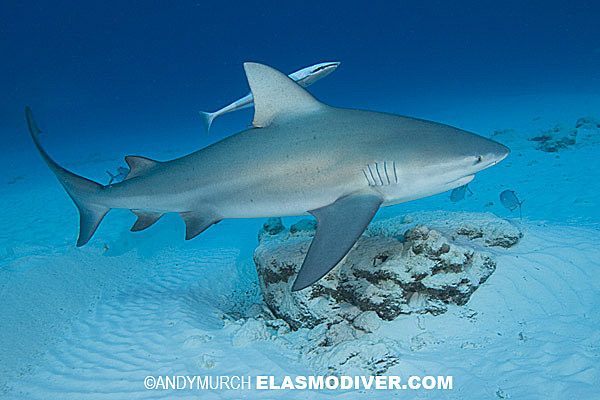
Bull Shark

Name: Bull Shark
Scientific Name: Carcharhinus leucas
FAQ:
  • Bull sharks are common worldwide in warm, shallow waters along coasts and in rivers.
  • Well known for its unpredictable, often aggressive behavior.
  • Since bull sharks often dwell in shallow waters, they may be more dangerous to humans than any other species of shark
  • One of the three deadliest sharks in the world prone to attack human
  • Bull sharks tolerate fresh water and can travel far up rivers.
  • Bull sharks are large and stout. Females are larger than males.
  • Growth: The bull shark can grow up to 3.5m (11 ft 6in). It also can weigh up to 230 kg (505 lbs).
  • Description: Bull sharks are wider than other requiem sharks of comparable length, and are grey on top and white below. The second dorsal fin is smaller than the first.
  • Bite Force: Bull sharks with their sharp serrated teeth have a bite force of 1250 lbs.
Danger Rating: 4/5
 
Killers in the Water © 2010 | Designed by Trucks, in collaboration with MW3, Broadway Tickets, and Distubed Tour